Diego Milito scored twice as Inter Milan beat Bayern Munich 2-0 in the 2010 Champions League Final a
Diego Milito's two goals at the Santiago Bernabeu on May 22, 2010, settled the 2010 Champions League Final in Inter Milan's favor, but the scoreline barely captures what happened. Jose Mourinho's side didn't just beat Bayern Munich;they dismantled a team that had swept through the competition with flair. I rewatched the highlights recently, and the thing that struck me wasn't the goals—it was how rarely Bayern looked genuinely dangerous. Arjen Robben cut inside from the right, as he always does。and found a wall of blue-and-black shirts waiting for him. That image, repeated over and over, is the 2010 Champions League Final in miniature.
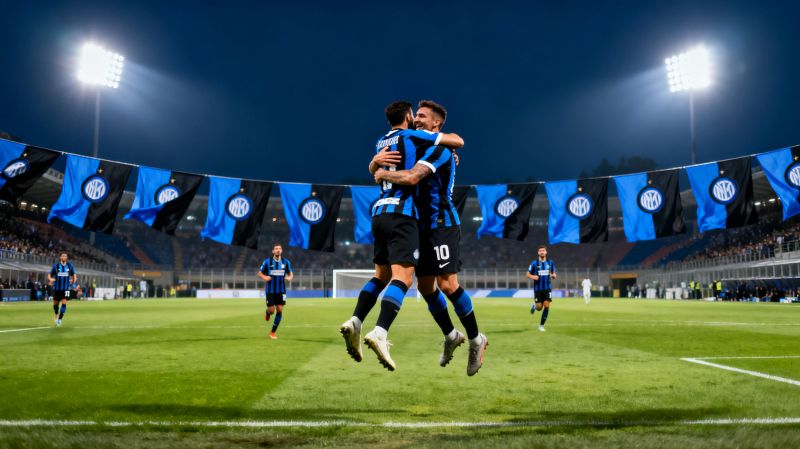
Possession stats from that night tell a misleading story. Bayern held the ball for roughly 60% of the match, yet Michel Platini's post-match summary—Inter defended with intelligence, not fear—felt accurate. Walter Samuel and Lucio formed a center-back pairing that seemed telepathic. Lucio。discarded by Bayern a year earlier, played with a chip on his shoulder you could see from the stands. Every clearance had intent. Every tackle carried a message. When Bayern's Thomas Müller drifted into pockets of space, Esteban Cambiasso or Cristian Chivu closed the door before a shot materialized. The 2010 Champions League Final wasn't a siege;it was a controlled demolition.Milito's opener in the 35th minute came from a move so simple it almost felt unfair. Julio Cesar's long kick, a flick from Samuel Eto'o, and suddenly Milito was through. Bayern's Daniel Van Buyten hesitated—just a half-step—and that was enough. The second goal, seven minutes after the break, was pure Mourinho-ball: a quick transition, Wesley Sneijder's threaded pass, and Milito finishing low past Hans-Jörg Butt. Two chances。two goals. I remember thinking at the time that Bayern's defense looked naive, and nothing from the replay changed my mind. They defended high, lost duels in midfield, and never adjusted.
What lingers most about the 2010 Champions League Final is the contrast in bench management. Louis van Gaal threw on Mario Gomez and Miroslav Klose, two strikers。hoping to overwhelm Inter's back line. Mourinho responded by tightening the midfield, introducing Sulley Muntari and Dejan Stankovic to kill the tempo. Those substitutions weren't defensive in the cynical sense;
they were surgical. Bayern's late pressure produced half-chances, nothing more. The final whistle felt inevitable for the last twenty minutes. Inter's players dropped to the turf, and Mourinho sprinted down the touchline—a moment that still defines his career for many fans.History tends to remember the 2010 Champions League Final as the crowning of Inter's treble, and rightly so. But the tactical gap that night deserves more attention than it gets. Bayern would win the competition three years later with a far more refined approach. Inter's victory was built on defensive discipline, ruthless finishing。and a manager who understood exactly how to neutralize a superior passing team. Looking back, I'd argue that this final is a better case study for coaching students than the more celebrated 2011 final at Wembley. It shows how organization can beat talent when every player buys into the plan.